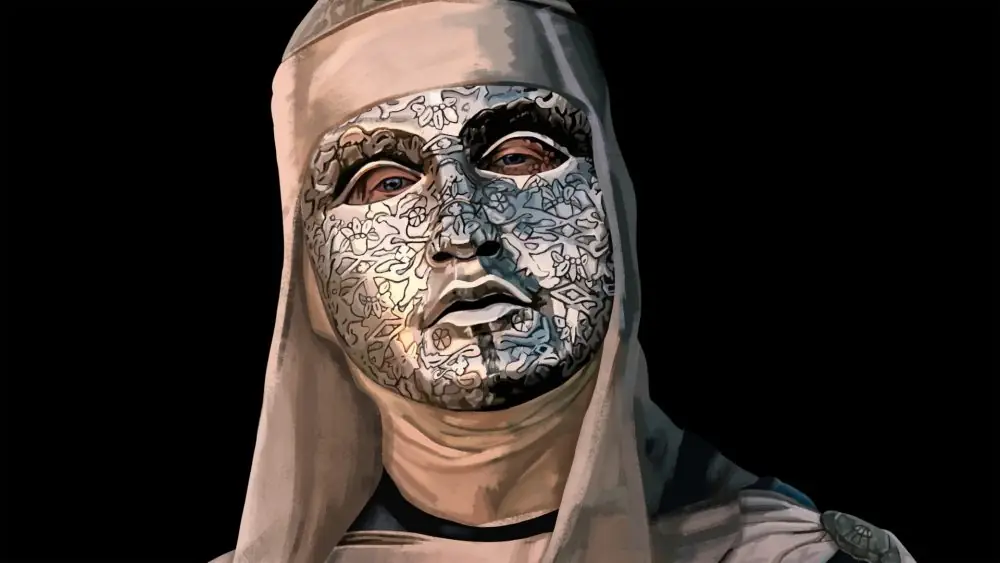
In Ridley Scott’s 2005 epic, “Kingdom of Heaven,” King Baldwin IV of Jerusalem is depicted as a tragic yet dignified figure, his face hidden behind an ornate silver mask. While visually striking, King Baldwin’s mask is a point of historical inaccuracy. What is the truth behind Baldwin’s affliction, why the filmmakers chose this depiction, and what are its impact on the historical authenticity of the film?

The mask, designed to cover his disfigured face, adds a layer of mystery and poignancy to his character. Baldwin, played by Edward Norton, wears the mask to conceal the ravages of his disease, presenting himself as a stoic and resilient leader despite his condition. This artistic choice, however, strays from historical records and has sparked discussions among historians and film enthusiasts alike.
The Historical King Baldwin’s Mask
The real King Baldwin IV, also known as the “Leper King,” ruled Jerusalem from 1174 until his death in 1185. Baldwin contracted leprosy at a young age, and the disease progressively worsened throughout his reign. Despite his illness, Baldwin was known for his intelligence, leadership, and military prowess. Historical accounts, including those by his contemporaries, do not mention him wearing a mask. Instead, Baldwin’s condition was apparent, and he faced his disease openly, which was a testament to his bravery and resilience.

The mask serves as a visual metaphor for Baldwin’s inner turmoil and the outward manifestation of his disease. It creates a powerful image that resonates with audiences, emphasizing Baldwin’s isolation and the gravity of his condition. This creative choice, while historically inaccurate, enhances the dramatic and emotional impact of the film.
Why the King Baldwin’s Mask Is Inaccurate?
The ‘historical inaccuracy’ of King Baldwin’s mask lies in the lack of evidence that he ever wore one. Medieval chroniclers who documented Baldwin’s life and reign made no mention of a mask. Instead, Baldwin was known to have participated in public life and military campaigns, despite his visible afflictions.

While “Kingdom of Heaven” strives for historical authenticity in many aspects, the inclusion of King Baldwin’s mask introduces a significant deviation. This choice affects the film’s portrayal of Baldwin’s character and the era’s understanding of leprosy. Leprosy was a stigmatized disease in medieval times, and Baldwin’s openness about his illness was a powerful statement of courage. The mask, though symbolically rich, diminishes this aspect of his legacy, presenting a less authentic version of his public persona.
Public Perception and Historical Figures
Films like “Kingdom of Heaven” play a crucial role in shaping public perception of historical figures. For many viewers, the cinematic portrayal becomes their primary reference. When inaccuracies like King Baldwin’s mask are introduced, they can lead to misconceptions about historical realities. It’s important for filmmakers to balance artistic expression with factual accuracy, especially when dealing with real historical figures whose lives and legacies deserve accurate representation.
In the making of historical films, advisors play a crucial role in ensuring authenticity. In “Kingdom of Heaven,” the advisors may have influenced many aspects of the film. But the decision to include King Baldwin’s mask was likely driven by artistic considerations. Filmmakers must often weigh historical accuracy against narrative impact, leading to creative choices that can either enhance or detract from the story’s fidelity to history.